
Smart Hiring: Level 2 Chimney Inspection Teaneck NJ: 2026 Guide for Ridgefield Residents
Most homeowners assume any chimney company can handle a level 2 chimney inspection, and that assumption costs them money. The inspection itself is a defined, standardized procedure, but the quality of the person performing it varies enormously, and in an older housing market like Ridgefield, where many homes date back to the 1950s and 1960s, that difference matters. A rushed, underdocumented inspection before a home sale or after a chimney fire can leave serious hazards undetected and put you in a difficult position with your insurance carrier or buyer’s attorney.
We wrote this guide as a neighbor would, not as a sales pitch. Our goal is to help you hire the right professional for a level 2 chimney inspection, whether that ends up being Teaneck Chimney or someone else.
What You Can Reasonably Do Yourself, and Where It Stops
There is real value in a homeowner doing a basic visual check before calling anyone. You can safely look at the firebox from inside the room, note obvious cracks in the fire brick, check whether the damper opens and closes cleanly, and look at the exterior crown from the ground with binoculars. If you see daylight through a mortar joint that should be solid, or white staining running down the exterior brick, those are signs worth documenting.
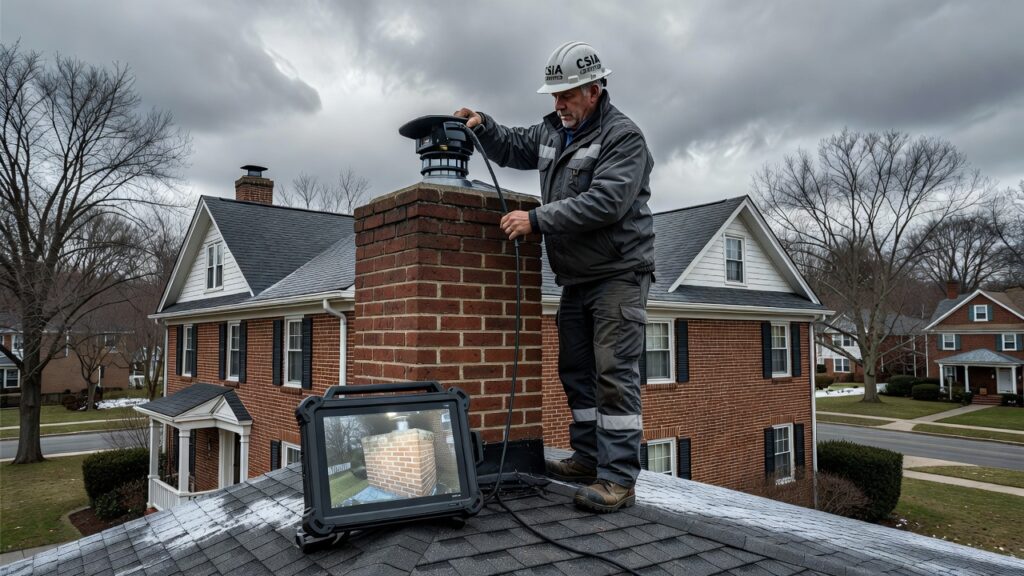
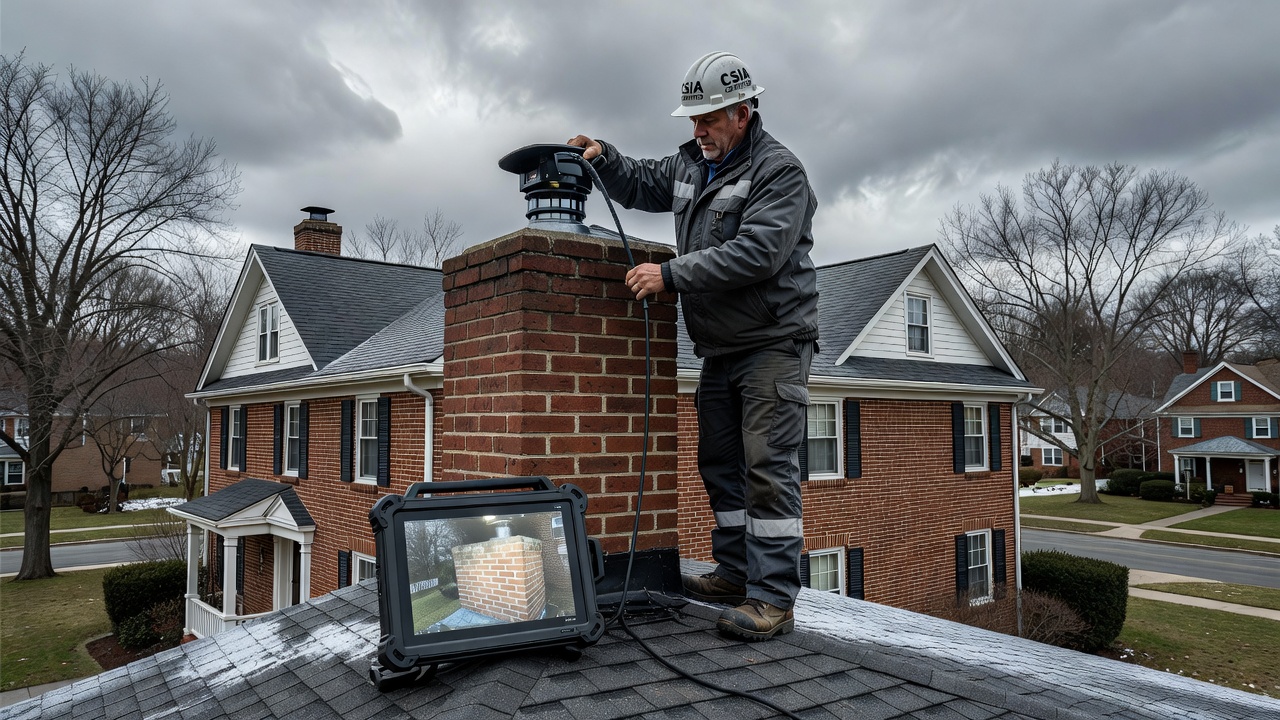
That is genuinely useful, and it saves time when a technician arrives. But it is also the limit of what DIY can accomplish here. A level 2 chimney inspection requires a camera system capable of imaging the full length of the flue from top to bottom, and the results need to be interpreted against the requirements in NFPA 211, the standard that governs chimney, fireplace, and venting system installation and inspection across the United States. According to NFPA 211 (2021 edition, which remains the adopted standard in New Jersey heading into 2026), a Level 2 inspection must include examination of accessible portions of the chimney exterior and interior, including attic, crawl space, and basement areas where accessible, as well as a video scan of the flue interior.
No smartphone app, no mirror on a stick, and no flashlight gets you there. The flue liner in a Ridgefield colonial from 1958 may look intact from the firebox but show significant horizontal cracking or spalling thirty feet up. That crack is invisible without equipment, and it is exactly the kind of defect that allows carbon monoxide or flame to escape into a wall cavity.
The Credentials That Actually Matter
The Chimney Safety Institute of America, known as the CSIA, offers the most widely recognized credential in this trade: the Certified Chimney Sweep designation. According to the CSIA, technicians holding this credential have passed a proctored exam and are required to maintain continuing education to stay current. That matters because code and best practices change. A technician who trained a decade ago and has not kept up may be working from outdated assumptions about liner sizing or clearance requirements.
Ask specifically whether the technician performing your inspection holds an active CSIA certification, not just the company. Some companies display credentials on their website that belong to one senior employee while less experienced staff handle the actual fieldwork. The person walking through your Ridgefield home and putting a camera in your flue should be the certified one.
Membership in the National Chimney Sweep Guild (NCSG) is a secondary indicator of a company that takes the trade seriously. It does not replace the CSIA certification but suggests the company invests in professional standards.
Questions Worth Asking Before You Book
You do not need to interrogate a contractor, but a few direct questions tell you a lot:
Will you provide a written report with the video footage, or just a verbal summary? A legitimate level 2 chimney inspection produces documentation. If a company quotes a low price but offers only a verbal walk-through, that is not a Level 2 inspection by definition.
What camera system do you use, and can I see still images or video from my inspection? This is not a technical gotcha question. It is a reasonable ask, and any experienced operator will answer it comfortably.
Are you licensed in New Jersey and carrying general liability and workers’ compensation insurance? New Jersey requires home improvement contractors to be registered with the Division of Consumer Affairs. Ask for the registration number and verify it at the state website before anyone sets foot on a ladder at your property.
Do you sub out any part of the inspection? Some companies book the job and send a subcontractor. That is not automatically a problem, but you should know.
What triggers a Level 2 versus a Level 1 in your assessment process? A company that cannot explain the difference clearly, or that tries to upgrade every job to a Level 2 without a legitimate reason, is worth scrutinizing. Level 2 is appropriate after any change of ownership, any fire event, after damage from a severe storm, or when switching fuel types. It is not needed every single year as a default.
Red Flags We Hear About From Homeowners Across Bergen County
A homeowner in Ridgefield called us a couple of years ago after a previous company had told her she needed a full reline immediately, quoted her over $4,000, and refused to provide the inspection report in writing. She had just bought her home and wanted a second opinion before signing anything. When our technician completed a proper Level 2 inspection with a documented video scan, the liner showed minor mortar joint deterioration, appropriate for the age of the chimney, not requiring immediate relining. She had a routine repair job, not a $4,000 emergency.
That pattern, a vague or verbal-only inspection followed immediately by a high-pressure upsell, is the most common red flag we hear about from homeowners across Fort Lee, Fairview, and New Milford. Others to watch for: no written quote before work begins, pressure to pay cash to avoid paperwork, and reluctance to provide proof of insurance before scheduling.
Unusually low prices are also worth questioning. A thorough Level 2 inspection in Bergen County in 2026 runs roughly $200 to $350 for a standard residential chimney, depending on height, access, and whether the property is in Englewood, Maywood, Oradell, or somewhere with more challenging access like Cliffside Park. A company quoting $79 is either cutting the inspection short or planning to make the money back on unnecessary repairs.
Comparing Quotes Without Getting Lost in the Numbers
When you receive quotes from multiple companies, the price matters less than what is included. Ask each company to spell out in writing: what equipment they use, whether you receive a written report with video documentation, whether the technician is CSIA-certified, and what the next steps would be if a defect is found. That last point is important. A company that inspects and repairs is not inherently conflicted as long as they show you the evidence, explain the options, and give you time to decide. A company that pressures you to authorize repairs the same day, before you have read the report, is a different story.
If a defect is found during a Level 2 inspection and repair is recommended, consider whether you want the same company handling both. There are good arguments either way. Using the same technician who found the problem can mean better continuity. Getting a separate repair quote from another company provides a check on the diagnosis. Both approaches are reasonable.
Talk to Us Before You Decide
Our technicians serve Ridgefield and the surrounding Bergen County communities, and we are straightforward about what we find and what it means. If you have questions about what a level 2 chimney inspection involves for your specific property, or you want to understand our process before booking, reach out through the contact form on our website. We are happy to answer questions before you commit to anything, because that is how we would want to be treated as homeowners ourselves.
Frequently Asked Questions About Level 2 Chimney Inspection Teaneck NJ
When is a Level 2 chimney inspection required versus a Level 1?
A Level 2 inspection is required any time there is a change of property ownership, after any chimney fire or external event like a lightning strike, when you switch fuel types or appliances, or when damage is suspected after a severe storm. NFPA 211 defines Level 2 as the minimum standard in these situations. A Level 1 is appropriate for a chimney that has had no changes and is being checked as part of routine annual maintenance.
How long does a Level 2 inspection take in a typical Ridgefield home?
For a standard single-flue chimney in a residential property, expect the technician to be on site for about 60 to 90 minutes. Older homes with multiple flues, a fireplace and a furnace connection for example, will take longer. The video scan alone takes time to run properly, and a thorough technician will also check the attic and basement access points.
Does a Level 2 inspection always lead to repair recommendations?
No. Many inspections come back clean or with only minor maintenance notes. The purpose of the inspection is to give you an accurate picture of the chimney’s condition, not to generate repair work. If a company tells you that every Level 2 inspection they perform turns up a major defect requiring immediate action, that is a pattern worth questioning.
Can I be present during the inspection?
Yes, and we encourage it. Being present lets you see the video footage in real time, ask questions as the technician works, and understand the findings before the written report is prepared. Any qualified technician should welcome a homeowner who wants to observe.
Is a Level 2 inspection required when selling a home in New Jersey?
New Jersey does not mandate a chimney inspection by statute as part of every real estate transaction, but most buyers’ home inspectors will flag a chimney as needing further evaluation, and many buyers’ attorneys now include a chimney inspection contingency. In practice, if you are selling a home in Ridgefield or anywhere in Bergen County with a working fireplace or wood stove, expect a Level 2 inspection to come up in the process.
What documentation should I receive after a Level 2 inspection?
At minimum, a written report identifying the areas inspected, the findings, and any recommendations for repair or further evaluation. The report should reference the applicable standard, typically NFPA 211, and be signed by the inspecting technician. Video documentation of the flue scan should be available, either provided directly or accessible on request. If a company cannot produce this, the inspection does not meet the Level 2 standard.
Related from Teaneck Chimney: Chimney Repair in Teaneck, NJ